
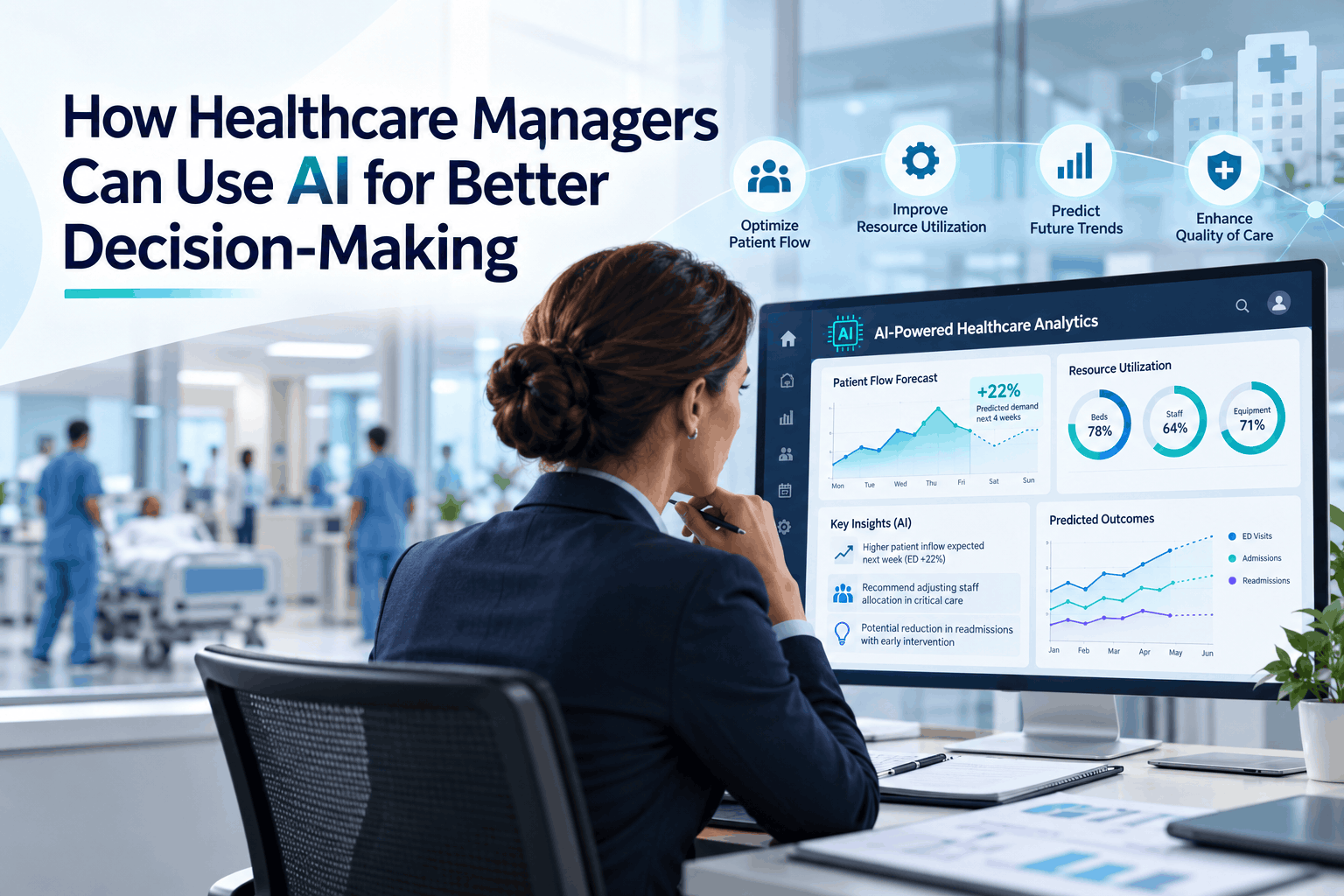
Healthcare managers can use AI for healthcare to make faster, better-informed decisions on the clinical as well as operational side of the hospital. On the operations side, it forecasts bed demand, plans staff rosters, and flags insurance claims likely to be rejected. On the clinical side, it supports doctors with decision-support alerts, speeds up scan reporting, and spots patients at risk of getting worse. AI in hospital management works by studying the data a hospital already collects and turning it into early warnings and forecasts.
Whether it’s a sepsis alert in the ICU or a bed forecast for admissions, healthcare managers have to choose the tool, fund it, check its safety, and give hands-on experience to responsible staff.
In this guide, you’ll see key hospital decisions AI can improve, a simple way to get started, and the skills you need to lead it.
What does AI in hospital management mean?
Put simply, it’s software that learns from the data your hospital already has (EMR, lab and imaging results, HIS, billing, pharmacy stock, duty rosters) and uses it to tell you what’s likely to happen next. Some of it is clinical, supporting doctors and nurses at the bedside. Some is operational, supporting the people who run the hospital. Managers need a working grasp of both, because even clinical tools have to be bought, checked for bias, and fitted into workflows. The call is still yours to make; AI just gives you a better view before you make it.
Types of AI healthcare solutions managers will use
Most AI healthcare solutions fall into four groups:
- Predictive analytics: forecast admissions, length of stay, and which patients are at risk.
- Clinical decision support systems (CDSS): suggest next steps or raise alerts at the bedside.
- Imaging and diagnostic AI: helps radiologists read X-rays and scans faster.
- Generative AI assistants: summarise discharge notes and analyse patient feedback.
Why is artificial intelligence in healthcare becoming a management priority?
Artificial Intelligence in healthcare is becoming a management priority because the decisions that make it work, like choosing tools, setting budgets, preparing data, and training staff, all align with healthcare managers. Three changes are pushing it up the agenda.
It’s more affordable. A September 2026 report on AI in Indian healthcare found that the cost of advanced AI tools has dropped by about 92% since 2023. Hospitals of every size can now consider it, not just large chains.
Hospitals need help with growing demand. Beds are often full, specialists like radiologists are in short supply, nurses are hard to retain, and more patients now come through government insurance schemes like PM-JAY. AI helps teams plan and spend their time where it matters most.
Most hospitals are still getting ready. The same report puts digital patient record use in India at only about 35%, and most AI projects are still small trials. Hospitals that get their data and teams ready now will be in a strong position to grow their use of AI.
Key Hospital decisions AI can improve
AI helps most with decisions that happen often, carry high stakes, and have data behind them.
1. Bed management and patient flow
Researchers have already used machine learning to forecast inpatient bed demand and length of stay. So the bed manager knows on Sunday that Tuesday will be tight, perhaps from monsoon dengue cases, and plans discharges around it. This is the kind of predictive analytics for hospital operations taught in IIHMR University’s AI for Healthcare Managers programme.
2. Workforce planning and rostering
Rosters are usually copied from last month. An AI scheduling tool looks at expected patient load instead, so you’re not overstaffed on a quiet Wednesday and short on a busy Saturday night.
3. Insurance claims and supply chain
Every rejected claim means lost revenue plus hours of follow-up. AI can check a claim before it goes out and spot missing documents in a pre-authorisation file. The same forecasting approach helps the pharmacy order what’s needed instead of writing off expired stock
4. Clinical decision support
Clinical decision support systems (CDSS) work inside the hospital’s digital patient records and act like a second pair of eyes for doctors. They can warn when two medicines shouldn’t be given together, when a patient’s test results are moving in the wrong direction, or when someone is showing early signs of sepsis, a serious reaction to infection. The manager’s role is to choose which warnings to turn on and keep the number manageable, so doctors take each alert seriously.
5. Medical imaging and diagnostics
AI tools can pre-read chest X-rays, CT scans, and mammograms and push urgent cases to the top of the radiologist’s list. For hospitals short on radiologists, that means faster reports. Managers should check that the tool was tested on patients and decide who signs off reports.
6. Patient safety and quality
AI can flag patients at risk of deteriorating on the ward or being readmitted after discharge, and spot clusters in infection and incident reports. That helps quality teams to fix the problems early, which also helps the hospital meet NABH accreditation standards for patient safety.
| Decision | AI application | Data needed | KPI to track |
|---|---|---|---|
| Bed management | Admission and length-of-stay forecasting | Admission/discharge records, OT schedule | Bed occupancy, ER wait time |
| Workforce planning | Demand-based rostering | Patient census, rosters, attendance | Overtime hours, attrition |
| Claims and supply chain | Denial prediction, stock forecasting | Claims history, pharmacy records | Claim denial rate, stock-outs |
| Clinical decision support | Drug, lab and sepsis alerts | EMR, lab results, prescriptions | Alert acceptance rate, adverse events |
| Imaging and diagnostics | Scan pre-reading and triage | X-ray, CT and MRI images | Report turnaround time |
| Patient safety and quality | Deterioration and readmission risk | EMR, vitals, incident reports | Readmission rate, infection rate |
How can hospitals use artificial intelligence responsibly?
Before you start any of these projects, it helps to get a few basics right. Artificial intelligence in hospitals works best when it’s built on a strong foundation, and that starts with good data. A model trained on complete, accurate, and representative records gives reliable, balanced advice.
Protect patient information under the consent and security rules of the Digital Personal Data Protection Act, 2023.
Use ICMR’s ethical guidelines for AI in biomedical research and healthcare as your reference point. They focus on accountability, transparency, fairness, and patient safety.
How to introduce AI in your hospital: a 5-step framework
With those basics in mind, here’s a simple way to start.
- Pick one decision. Choose something costly that happens often, like daily bed planning or radiology turnaround.
- Look hard at your data. Are HIS and EMR records complete? Can different departments share data, ideally to ABDM standards?
- Pilot it for about 90 days. Record your current numbers first so you can measure improvement.
- Decide who’s in charge. Name an owner for each decision and agree when staff can overrule the tool.
- Then scale. If the pilot works, add monitoring and training before a wider rollout.
Before you buy any tool, ask the vendor where patient data is stored and whether the tool can explain its predictions.
What skills do healthcare managers need to lead AI adoption?
You don’t have to become a programmer. But a hands-on feel for how AI works helps a lot: running a simple analysis, seeing how a machine learning model makes a prediction, and knowing where it can go wrong. You’ll also need to redesign workflows, understand data privacy and ethics, and judge vendor proposals.
These skills are in short supply, and the lack of AI-ready talent is a major barrier for Indian hospitals.
Build these skills with IIHMR University’s Artificial Intelligence for Healthcare Managers programme
IIHMR University’s AI for Healthcare Managers is a 12-week live online certificate programme for people who want to lead AI projects in hospitals and health systems. You’ll learn basic Python and machine learning in browser-based notebooks, using synthetic Indian healthcare datasets. Topics include AI fundamentals, healthcare analytics, data visualisation, clinical decision support, predictive analytics for hospital operations, AI in imaging and diagnostics, and AI ethics and bias. You’ll also learn how to judge vendor proposals.
- Duration: 3 months (12 weeks), 48 learning hours, 3 credits
- Mode: Live online, faculty-led, with hands-on practice
- Assessment: Quizzes, notebook assignments, group case discussions, and a capstone project
- Eligibility: Graduate in any discipline
- Certificate: Certificate of Completion from IIHMR University, Jaipur
- Fee: ₹30,000 + 18% GST (India); US$315 + 18% GST (international); early-bird and group discounts available
- Programme Coordinator: Dr. Aditya Saxena, Associate Professor, IIHMR University
Conclusion: AI supports the decision; the manager owns it
AI won’t run your hospital, but it can sharpen decisions on the ward and in the office. Start with one decision and measure what changes. To lead that work, apply for IIHMR University’s Artificial Intelligence for Healthcare Managers programme.
Frequently asked questions
How is AI used in hospital management?
On the operations side, for bed forecasts, rosters and claim checks. On the clinical side, for decision-support alerts, faster scan reporting and spotting high-risk patients. Managers and clinicians still make the final call.
What are examples of AI healthcare solutions in Indian hospitals?
Bed forecasting, automated rostering, claim checks, clinical decision support alerts, and AI-assisted reading of X-rays and scans. Most are still pilots.
Will AI replace hospital administrators?
No. It takes over number-crunching, but humans still handle people management, trade-offs, and accountability. Administrators who can use AI well will have the edge.
What data does a hospital need before adopting AI?
Reliable digital records: EMR and HIS data, lab and imaging results, admissions and discharges, billing, inventory, and rosters. The more complete and connected they are, the better the results.
Do healthcare managers need coding skills to use AI?
No. Most AI tools work through dashboards. Basic Python and data analysis help you judge AI outputs, and the IIHMR University programme teaches both from scratch.
Which course can help healthcare managers learn AI?
IIHMR University’s Artificial Intelligence for Healthcare Managers is a 12-week live online certificate (48 hours, 3 credits). It ends with a capstone project.
References
- https://www.business-standard.com/industry/news/ai-application-in-indian-healthcare-rising-but-adoption-uneven-report-126090800915_1.html
- https://pmc.ncbi.nlm.nih.gov/articles/PMC8889525/
- https://pmc.ncbi.nlm.nih.gov/articles/PMC11288104/
- https://www.meity.gov.in/static/uploads/2024/06/2bf1f0e9f04e6fb4f8fef35e82c42aa5.pdf
- https://www.icmr.gov.in/ethical-guidelines-for-application-of-artificial-intelligence-in-biomedical-research-and-healthcare