
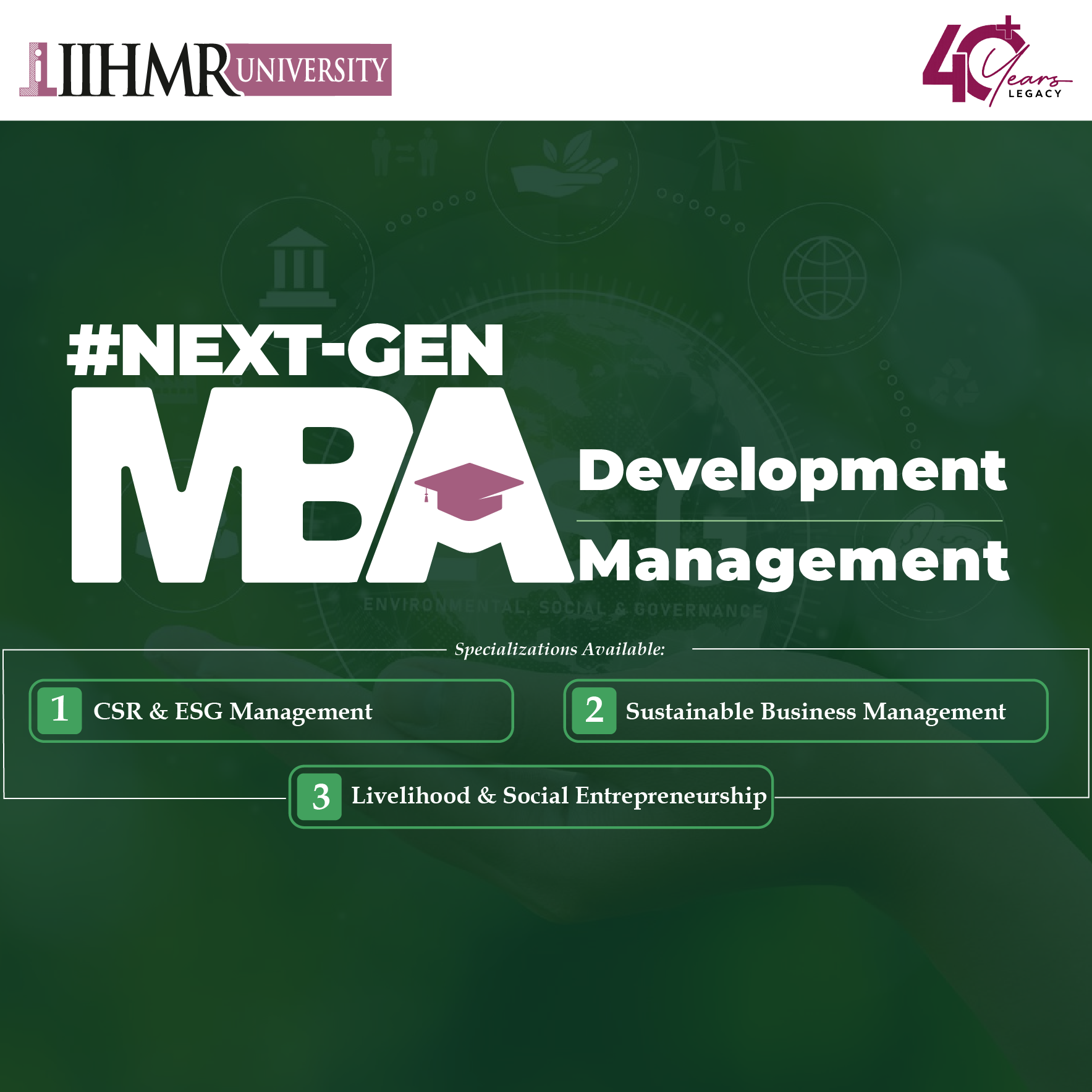
MBA in Development Management: Overview of the Program
The MBA in Development Management is a future-focused, high-impact programme designed
for ambitious leaders who want to combine business excellence with meaningful societal
transformation. This two-year, full-time MBA equips students with strong foundations in
finance, strategy, economics, and analytics, seamlessly integrated with public policy,
sustainability, climate action, and social innovation.
What makes this programme truly distinctive is its powerful industry alignment and career
relevance. With over 1000+ leading companies actively investing in sustainability, CSR, and
ESG initiatives—and India alone witnessing an annual CSR spend exceeding ₹30,000 crore—
graduates step into a rapidly expanding ecosystem of opportunity and influence.
After a robust first year, students specialise in high-growth domains: CSR & ESG Management
(CEM), Sustainable Business Management (SBM), or Livelihood & Social Entrepreneurship
(LSE)—each opening doors to leadership roles across corporates, international organisations,
consulting firms, and impact enterprises.
This MBA shapes professionals who can drive strategy in boardrooms while creating
measurable change on the ground—leaders who understand both profit and purpose and are
ready to lead the next wave of responsible, inclusive growth.
1. Specialisation in CSR and ESG Management
Emerging Importance:
CSR and ESG have become central to corporate strategy, driven by regulatory frameworks and
investor expectations. With 1000+ top companies actively investing and India’s annual CSR
spend exceeding ₹30,000 crore, organisations are seeking professionals who can align
compliance with meaningful impact. This specialisation places you at the heart of responsible
business transformation.
Core Competencies:
Students develop expertise in CSR strategy, ESG frameworks, impact assessment, and
sustainability reporting. The curriculum builds skills in designing high-impact programmes,
regulatory compliance, and sectoral interventions across health, livelihoods, climate resilience,
and WASH, ensuring strong analytical and implementation capabilities.
Scope of Job:
Graduates access dynamic roles in corporate CSR and ESG divisions, sustainability consulting
firms like Deloitte, EY, KPMG, and PwC, global development organisations, and foundations
—leading strategy, reporting, and impactful programme execution.
2. Specialisation in Sustainable Business Management (SBM)
Emerging Importance:
Sustainability is redefining global business, making it a boardroom priority. With India’s net-zero commitments and rapid expansion of green industries, organisations require leaders who
can integrate environmental responsibility with profitability and innovation.
Core Competencies:
This specialisation builds expertise in environmental management, circular economy,
sustainable supply chains, carbon accounting, and sustainable finance. Students learn to apply
global standards, manage climate risks, and embed sustainability into core business strategy.
Scope of Job:
Graduates step into roles such as sustainability managers, ESG consultants, and green finance
professionals across corporates, consulting firms, renewable energy companies, and emerging
climate-tech startups.
3. Specialisation in Livelihood and Social Entrepreneurship (LSE)
Emerging Importance:
India’s evolving rural economy and focus on inclusive growth have created a strong demand
for leaders who can build sustainable livelihood systems and social enterprises that drive large-scale impact.
Core Competencies:
Students gain practical expertise in social enterprise design, rural finance, FPO development,
inclusive value chains, and livelihood systems. Strong field immersion ensures the ability to
translate business strategies into grassroots impact.
Scope of Job:
Graduates pursue roles as social entrepreneurs, livelihood programme managers, rural finance
professionals, and impact investors across NGOs, enterprises, banks, and national and global
development institutions.
How do the Three Specialisations Compare?
| Dimension | CSR & ESG | Sustainable Business | Livelihood & Social Entrepreneurship |
|---|---|---|---|
| Primary employer | Corporates, Consulting Firms/ NGOs | CCorporates, Consulting Firms/ NGOs | NGOs, Social Enterprises, Producer Organisation, Government Organisations |
| Work setting | HQ, boardrooms | HQ, strategy teams | Field, rural, hybrid |
| Core skill | Compliance + impact | Strategy + sustainability | Enterprise + community |
| Best for | Corporate-track candidates | Strategy-minded sustainability leads | Founders and field leaders |
Why MBA in Development Management—Why Now?
India stands at a powerful intersection of growth and responsibility. With annual CSR
investments exceeding ₹30,000 crore and ESG-led strategies expanding across 1000+ leading
companies, the demand for professionals who understand both business and impact is
accelerating rapidly. At the same time, sectors like sustainable business, climate action, and
rural livelihoods are becoming structured, data-driven, and professionally managed.
An MBA in Development Management equips you with this rare dual capability—combining
strong managerial expertise with purpose-driven leadership. Whether it is leading ESG
strategy, building sustainable enterprises, or transforming grassroots economies, this
programme opens diverse, high-growth career pathways. It prepares you not just for jobs, but
for meaningful leadership in sectors that are shaping the future of India and the global economy.
Final Thought
The future belongs to leaders who can balance profit with purpose and growth with
responsibility. Success will increasingly be defined not only by financial performance, but by
social impact, environmental stewardship, and ethical governance.
The MBA in Development Management, with its focused specialisations in CSR & ESG,
Sustainable Business, and Livelihood & Social Entrepreneurship, prepares you to lead this
transformation. It empowers you to create solutions that are scalable, sustainable, and
impactful.
Choosing this programme means stepping into a career that goes beyond conventional
boundaries—where you don’t just build organisations, but shape communities, influence
industries, and contribute to a more inclusive and sustainable world.
Frequently Asked Questions
What is the MBA in Development Management, and how is it different from a regular MBA?
A two-year MBA combining business fundamentals with sustainability and development.
Unlike traditional MBAs, it prepares you to drive both financial performance and measurable
social and environmental impact.
Who should consider this programme?
Ideal for graduates from any discipline and professionals aiming for careers in CSR, ESG,
sustainability, social enterprise, or development leadership across corporates, NGOs, and
public systems.
How do I choose between the three specialisations?
Choose based on your passion: CSR & ESG for corporate impact roles, Sustainable Business
for strategy and green innovation, and Livelihood & Social Entrepreneurship for grassroots
transformation and enterprise creation.
What are the career options after an MBA in Development Management?
Opportunities span corporate ESG/CSR teams, sustainability consulting, impact investing,
development agencies, multilateral organisations, and social ventures—offering diverse, high-growth career pathways across sectors.
What’s the salary range after this MBA?
Graduates typically start between ₹6–12 LPA. With experience, roles in ESG, consulting, and
leadership positions can grow significantly, often reaching ₹15-20 LPA and beyond.
What are the eligibility and admission requirements?
A bachelor’s degree (minimum 50%) with valid scores in CAT/XAT
/CMAT/MAT/ATMA/GMAT/CUET-PG/I IHMR-U MAT, followed by group discussion
and personal interview. Work experience is valued but not mandatory.