
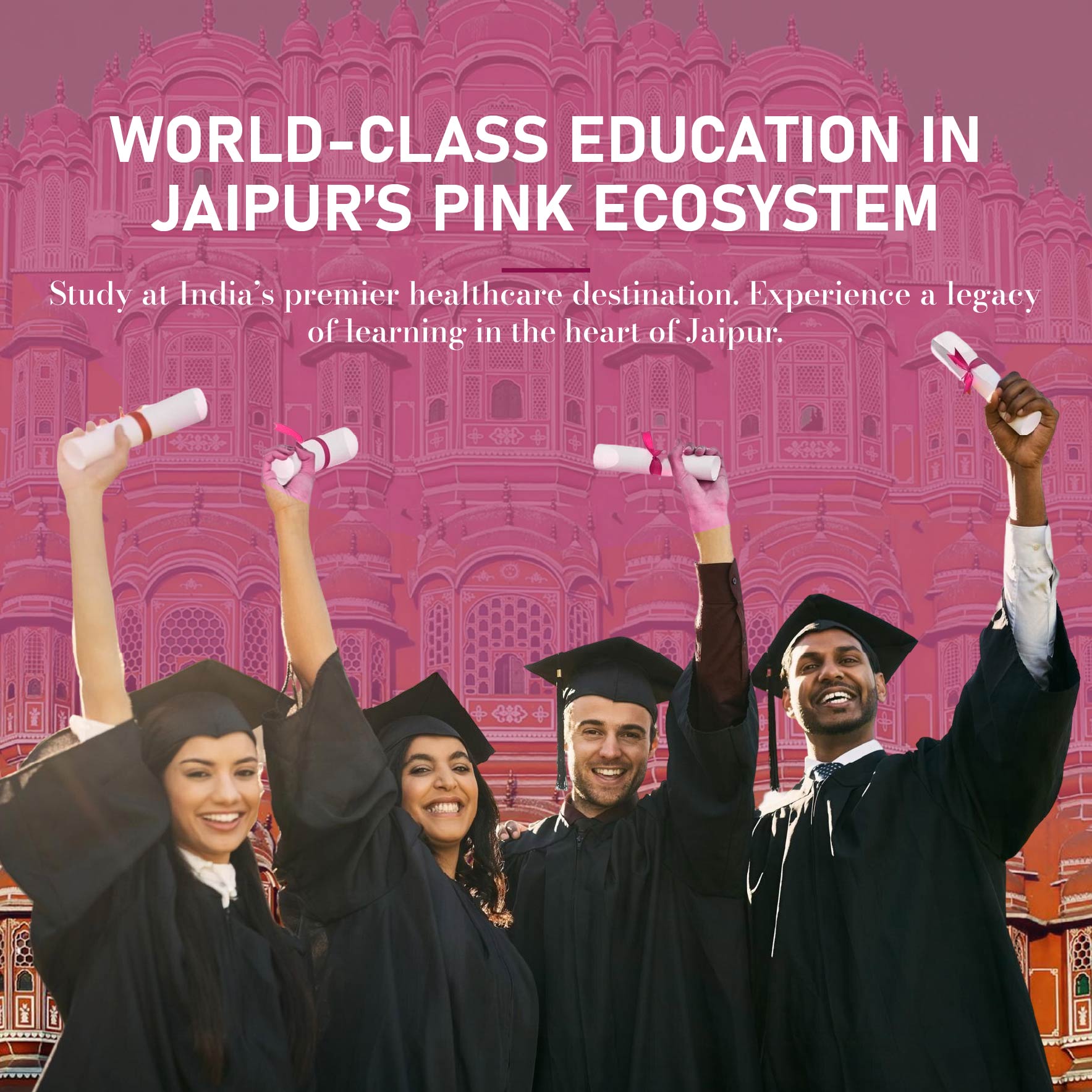
For generations, ambitious students left Jaipur for Delhi, Mumbai, or Bengaluru without a second thought. The metros held the institutions, the networks, the prestige.
That calculus is changing.
Jaipur is emerging as a preferred destination for graduate and executive education – particularly in Health Management, Public Health, Pharmaceutical management, Digital health, Healthcare Analytics, and Development Management (CSR, ESG, sustainability, and social entrepreneurship). At the centre of this shift stands a 40+ years vintage university that most people outside the sector still underestimate: IIHMR University.
The City Itself Is the Advantage
This is not a story about one institution or one programme. Jaipur offers a combination that is genuinely hard to match anywhere in North India — rail, road, metro, and air connectivity, all working together. An international airport. Direct links into the Delhi–Mumbai corridor. A calmer, cleaner, more affordable life than any major metro. Campuses that are actually green. Commutes that don’t cost you two hours a day. A safety record that parents trust. Education analysts now consistently rank Jaipur among India’s leading tier-2 education cities. The conversation has moved from “it’s a good backup option” to “it’s where serious students go.”Why the Tier-2 Shift Is Happening Now
The pull of the metros was always built on three things: institutions, employer access, and signalling. For most of the last two decades, the cost of being elsewhere was simply too high — students went where the jobs and the brands were. Three things have shifted that equation. First, employers themselves have become geography-agnostic for most analytical and management roles, with hybrid work and structured campus recruitment now reaching well beyond the metros. Second, infrastructure in cities like Jaipur — expressways, the metro, expanded airport capacity, fibre-grade connectivity — has closed the gap on the practical advantages metros once monopolised. Third, and perhaps most importantly, the cost-of-living delta has widened to a point where a metro postgraduate education quietly extracts a premium that often outlasts the degree itself in the form of student debt and delayed savings. In that environment, a tier-2 city with a serious institution is not a compromise. It is a recalculation.IIHMR University: The Institution That Built This Identity
Founded in 1984, long before healthcare management was a mainstream ambition in India, IIHMR University made a singular bet — that health systems need managers as much as they need doctors. Four decades later, that bet has compounded into something remarkable. Recognised by the Ministry of Health and Family Welfare as an Institute of Excellence. A WHO Collaborating Centre for district health systems. Programmes spanning the MBA in Hospital and Health Management, Pharmaceutical Management, Master of Public Health, healthcare analytics, PhD, and executive education, MDPs, and online certification programmes built for working professionals who cannot pause their careers. The alumni are now in health departments, hospitals, NGOs, consulting firms, and multilateral agencies — from India to global health organisations worldwide.The Recognition the Sector Has Quietly Awarded
If the rest of the country has been slow to notice, the sector itself has not. Education World ranked IIHMR University the #1 Health Management University in India in both 2025 and 2026. The Times B-School Ranking 2026 placed it at #15 among Indian business schools — striking for an institution that, by design, has resisted the temptation to chase a generalist business-school identity. On the global axis, the Times Higher Education Impact Rankings 2024 placed IIHMR in the 101–200 band worldwide and 6th among Indian universities for SDG 3 (Good Health and Well-being). For an institution whose entire purpose is health systems, that is the ranking that matters most. It is also a quiet reminder that an institution does not need to be in a metro to do globally relevant work.What’s Being Built Right Now?
Dr. P. R. Sodani, President of IIHMR University, has been consistent in his vision: IIHMR is evolving from India’s premier health management research institution into a dynamic hub for healthcare, public health, digital health, AI, health-tech start-ups, and impact-driven management education. On the Jaipur campus, students, researchers, clinicians, entrepreneurs, and industry leaders are converging — collectively reimagining how healthcare is delivered and managed in India and beyond. That is not the description of a university. That is the description of an ecosystem, and of a vision.What That Ecosystem Actually Looks Like
It is one thing to call something an ecosystem. It is another to point at the parts. At IIHMR, those parts are unusually concrete. The university operates through five distinct schools — the Institute of Health Management Research, the School of Pharmaceutical Management, the ML Mehta School of Development Studies, the SD Gupta School of Public Health, and the School of Digital Health. Each one is a deep specialisation in its own right, and together they cover almost every functional gap a modern health system has to fill. Layered on top are the research centres — the Centre for Health Economics, the Centre of Gender Studies, the Centre for Innovation, Incubation and Entrepreneurship, the Centre for Behavioural Sciences, the Centre for Clinical Research, and the Centre for Environmental Health. These are not nameplate centres. They run live projects in collaboration with the Ministry of Health and Family Welfare, the World Health Organization, UN agencies, and international development partners. And then there is PRADNYA — the university’s flagship international conference on Global Health Management Research — which brings scholars, policymakers, and industry leaders to Jaipur every year. It is the kind of gathering that, until very recently, would have happened in Delhi or Mumbai by default. It does not anymore.A Global Career, Built in Jaipur
For students from India and neighbouring South Asian countries — where specialised health management programmes remain scarce — Jaipur now offers something genuinely rare: global-standard curricula, international faculty collaborations, and real-world health systems exposure, at a fraction of what overseas alternatives cost. Pathways into governments, hospitals, NGOs, consulting, and global health agencies — built right here. The substance behind that claim is real. IIHMR has trained mid- to senior-level executives from more than 40 countries — administrators, policymakers, and programme managers who came to Jaipur because the work being done here was genuinely useful to them. The university’s long-running collaboration with Johns Hopkins University, USA, runs the Bloomberg School of Public Health’s globally ranked MPH programme in cooperation with IIHMR for participants from India and surrounding countries, with a Summer Institute component in Baltimore. Active academic partnerships extend across the United Kingdom, Canada, Malaysia, Indonesia, and other countries, supporting joint research, faculty exchange, and student mobility. In other words, the international exposure is not an aspiration written on a brochure. It is a working programme.Where is This Going?
India’s next wave of higher-education growth will come from tier-2 cities. Rising metro costs, improving infrastructure, greener campuses, more liveable environments — the advantages are compounding. Jaipur is exceptionally positioned. Strong connectivity. A rich cultural identity. A growing innovation economy. And IIHMR University, an institution that has spent 40+ years proving that world-class healthcare management education doesn’t need a Mumbai address. For anyone looking to build a career in healthcare, public health, or health-tech, Jaipur now offers something rare. A city that inspires. An institution that prepares. And an ecosystem that is only getting stronger.FAQS
1. Why choose Jaipur over Delhi, Mumbai, or Bengaluru for a health management education?
Metro rents and commutes now consume a real share of a student’s time and money. Jaipur offers the same connectivity without the daily tax and for a specialised field, the institution matters more than the postcode. IIHMR gives the city forty years of depth in one discipline, done seriously.2. How is IIHMR University different from a business school with a healthcare specialisation?
At a general MBA, healthcare is a track. At IIHMR, it is the reason the university exists. The curriculum was built from the real problems of Indian hospitals, health systems, and pharma — not bolted on to a management framework.3. Where do IIHMR graduates actually work?
Hospital systems, pharma companies, health-tech start-ups, consulting firms, NGOs, government health departments, and multilateral agencies. The common thread is organisations that need people fluent in both management and health.4. Is the programme for fresh graduates or mid-career professionals?
Both. Full-time postgraduate programmes serve students moving straight from undergraduate study. Executive, MDP, and online certifications serve working professionals who cannot pause their careers.5. For a South Asian student, what does Jaipur offer that the UK or Australia cannot?
International-standard curricula at a fraction of the cost, exposure to the health systems students will actually work in, and placement networks that extend across the region. A practical proposition, not a compromise.6. What is the IIHMR campus and student life actually like?
The campus is a 14-acre green space in the heart of Jaipur, with on-campus hostels, a research-grade library with global database access, smart classrooms, sports and recreation facilities, and a wellness infrastructure. Beyond academics, festivals, TEDx events, seminars, and the flagship PRADNYA conference give the campus an unusually active intellectual culture for a city of Jaipur’s size.7. Why is Jaipur emerging as a tier-2 education hub right now?
The combination is unusual: an international airport, the Delhi–Mumbai expressway, the metro, a lower cost of living than any major metro, and a safety record that parents trust. Layer in serious institutions doing nationally and globally recognised work, and the rationale for choosing Jaipur over a metro stops being sentimental and starts being practical.Abbreviations:
- WHO – World Health Organization
- MPH – Master of Public Health
- MDP – Management Development Programme
- CSR – Corporate Social Responsibility
- ESG – Environmental, Social, and Governance
- NGOs – Non Governmental Organizations